Sunday, July 17, 2011

Fourth week at Gabii

A pattern of oppressive heat and humidity gave way after mid-week and we finished this, our fourth week of the 2011 campaign, under beautiful skies at Gabii. Gabii Project veterans continue to marvel at Gabii's unique weather patterns, seemingly still influenced by the crater lake of Castiglione, although the lake was drained a long time ago. The winds helped to make the temperatures lovely for fieldwork - although the occasional blown paperwork or silt in the eye was a downside to the windy weather. In terms of archaeology, we had a productive week. In Area C we continued to delimit a Republican structure and in Area E a lot of hard work cleaning top soil and colluvium is starting to reveal interesting and promising wall features, in addition to more evidence for Gabii's street system. Elsewhere on the site we continue to work to complete the excavation of a structure in our Area B as well as to document and model various features, including digital tomb modeling. Our lecture program this week included presentations by Hilary Becker (Davidson College) on the inland economy of ancient Italy and by Ruth Beeston (Davidson College) on XRF and chemical applications in archaeology. Mid-week we were invited to visit the excavations of our 'neighbor' Marco Fabbri who is working at the site of an archaic building on the rim of the crater of Castiglione. To top off a great week, a number of the team joined Jeffrey Becker and Hilary Becker for a visit to the ruins of Ostia Antica on Saturday. All enjoyed a fun day walking and talking amidst the ruins. As we move on to the fifth week of this year's campaign, we look forward to what is sure to be an exciting new round of discoveries. The project also joined Google+ this week, so come join our circle(s)!


Austin Raymond (Davidson College).

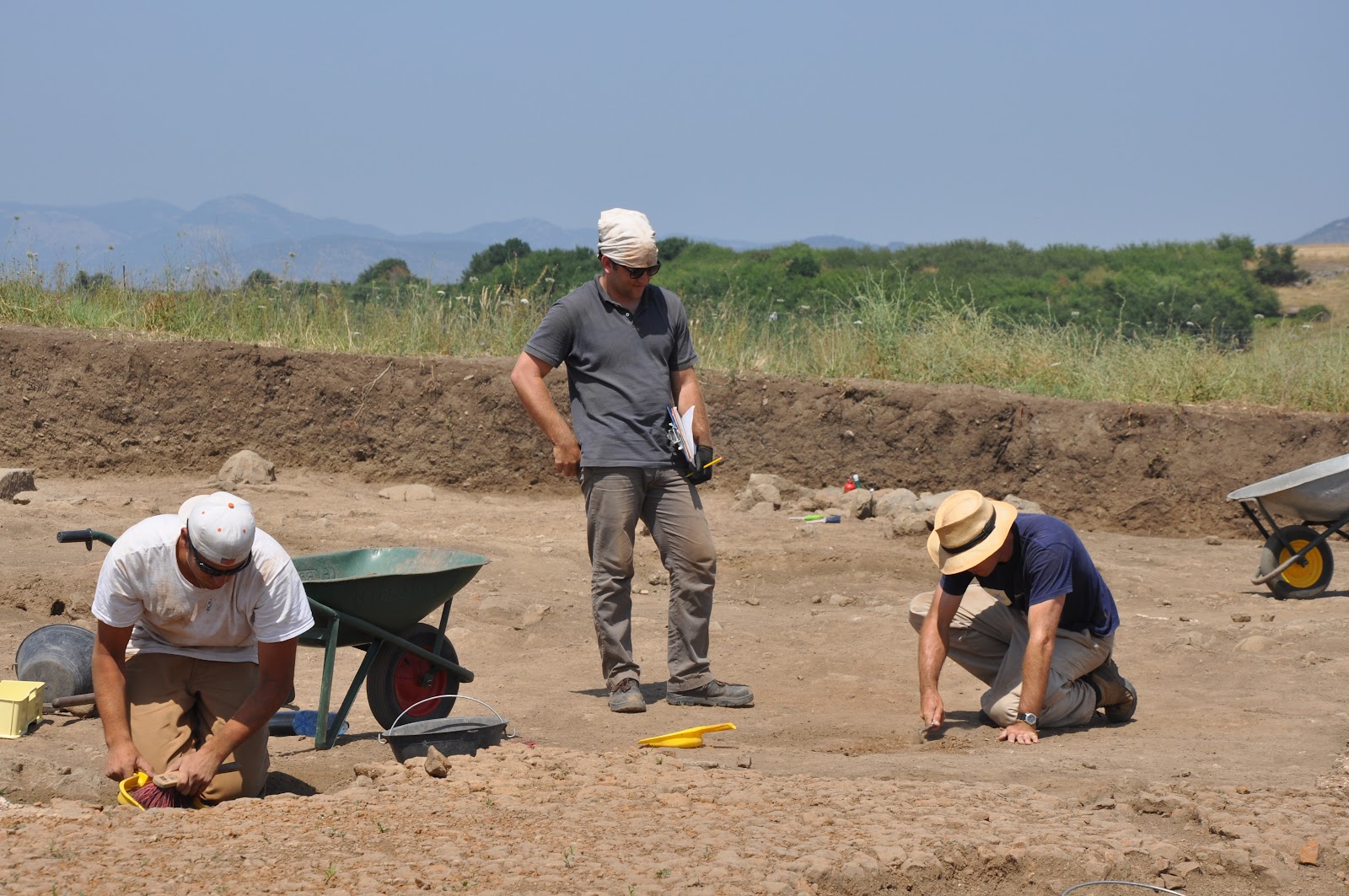
Evan Goldstick (Michigan), Samuel Palumbo (Bryn Mawr) work with supervisor Jamie Sewell.

Ruth Beeston talks about chemistry and archaeology.


Part of our group at the sanctuary of Attis in the Campus of the Magna Mater. (l to r, starting with back row: Brandon Tomasso, Jacob Kovacs-Goodman, Evan Levine, Sheira Cohen, Jonathan Flynn, Julia Reilly, Aida Ali, Jackson Vaughn, Tim Hart, Ruth Beeston, Michael Beeston, Hilary Becker, Austin Raymond, Evan Goldstick, Nick Bartos, Christina Cha, Ilana Hill, Zoe Fox, Lauren Coughlin.

Part of our group at the Capitolium. (l to r, starting with back row: AJ Chrapliwy, Jackson Vaughn, Sam Palumbo, Evan Goldstick, Amanda Swango, Tim Hart, Austin Raymond, Sheira Cohen, Jeffrey Becker, Jacob Kovacs-Goodman, Brandon Tomasso, Sophia Staley, Laura Steitz, Carrie Wallace, Lauren Coughlin, Jonathan Flynn, Nick Bartos, Julia Reilly, Zoe Fox, Alison Rittershaus, Aida Ali, Ilana Hill, Christina Cha, Evan Levine.


Sunday, July 10, 2011

Gabines on the Ianiculum?

Yes, it can happen - a geographic convergence of sorts, Gabines coming to the hills of Rome. This was the case on the evening of Saturday, July 9, 2011, when the American Academy in Rome and the University of Michigan's Office of Development hosted a reception for friends of the Gabii Project in the Academy's Bass Garden. Welcoming the group were project director Nicola Terrenato, Brodie Remington from the Office of Development, and T. Corey Brennan, the Andrew W. Mellon Professor-in-Charge of the School of Classical Studies at the American Academy. The welcome highlighted the strengths of the University of Michigan and its tradition of Roman studies and Classical archaeology, as well as the ties between the two institutions. After a discussion in the garden about the aims of the Gabii Project, the group adjourned to the Casa Rustica on the Academy's grounds for a visit with the lead sarcophagus excavated at Gabii in 2009. It was a lovely evening - with perfect weather - and the Gabii Project is grateful to its friends and supporters for coming out to share in both a lovely evening in Rome and in our fieldwork outcomes.


Saturday, July 9, 2011

Third week of the 2011 season

It seems unbelievable that we have reached the mid-way point of the 2011 field season. Things on-site at Gabii are so busy and our team (85 persons strong) is working so hard that time seems to be flying by this summer. Our week was very productive and was fortunate for good weather, save one rainy day. The excavations in Areas C, D, and E continue to work to delimit parts of city blocks, including phases that pre-date the imposition of Gabii's street grid that was exposed by survey. This involves looking not only for limits with respect to the blocks, but also to untangling what is looking to be a multi-phase architectural chronology. Area E (our newest area) is still in the process of clearing colluvial layers, but has in so doing exposed some promising wall tops and important evidence of our easternmost side street.

Stormy skies over the Ager Gabinus.

Sophia Staley (Brown) and David Zackheim (Williams) work with assistant supervisor Marilyn Evans (Berkeley), at center.

Laura Wilke (Cornell) and Bailey Benson (UPenn) work sorting pottery.

Area B Team on 8th July 2011 with supervisor Claudia Melisch, at center.
At the Villa Mercede we had two engaging lecture presentations by Nicola Terrenato and Abigail Crawford, respectively. Terrenato's talk on stratigraphy and the Harris matrix pushed students to think about the relationship of stratigraphic contexts on an archaeological site and the challenges of organizing stratigraphic information in a usable and lucid way. Crawford's talk on archaeological materials included a 'practical' component wherein students were given finds data and stratigraphic data for various units and asked to offer interpretations on that basis. Both exercises were very useful for our group.

Nicola Terrenato discusses the Harris matrix.
Abby Crawford discusses archaeological materials.

Alison Rittershaus (Harvard)

Nicola Terrenato capped the week with a presentation at the Koninklijk Nederlands Instituut Rome in tandem with a presentation of the publication of the Regional Pathways to Complexity Project. The event enjoyed an excellent turnout and the Gabii Project is extremely grateful to the Dutch Institute for the invitation to include our work in their event. On we go to the fourth week!

Nicola Terrenato discusses Gabii Project research on July 8, 2011.

Saturday, July 2, 2011

Second week at Gabii - full steam ahead!

Somehow we have reached the end of the second full week of work with the full team on-site. In spite of a day of rest mid-week for the SS. Peter and Paul holiday, the week was very full, busy, and productive. We welcomed on-site 25 new student volunteers from the American Institute for Roman Culture in Rome who will spend the remainder of July working with our team. Some of them have joined existing excavation teams while others have formed a new team that is tackling a new area (Area E), so we welcome their arrival and participation.


Elsewhere on the site things are in full swing. The environmental lab is processing soil samples of all kinds, as well as setting up for what is to be a robust campaign of dry-sieving of soon-to-emerge occupation layers. In the finds lab the staff is working to collect and collate data on past season's finds, all the while processing new cassette as they come from the field.

For the 'diggers' work continues on structures in three of our areas, at this point the main goal is the delimiting of the ground plans of these buildings. To that end, we are working on a further expansion of one of our excavation baulks. On this, a beautiful Italian Saturday, we look forward to the upcoming third week of the 2011 campaign.


Friday, July 1, 2011

Gabii Project at the Koninklijk Nederlands Instituut Rome


On July 8, 2011, at 18.00, the occasion of the presentation of the new volume Regional Pathways to Complexity: Settlement and Land-Use Dynamics in Early Italy from the Bronze Age to the Republican Period by Peter Attema, Gert-Jan Burgers, and Martijn van Leusen (Amsterdam, 2011) will provide the occasion for a presentation by Nicola Terrenato on the recent work of the Gabii Project under the title "The Gabii Project: Recent discoveries and perspectives".


The event is open to the public.

Koninklijk Nederlands Instituut Rome
Via Omero 10/12
00197 Rome, Italy

For more information, contact the Gabii Project (gabii.project (at) gmail (dot) com). For information on the venue or directions, please contact the Royal Netherlands Institute at Rome <archeo@knir.it>.

Sunday, June 26, 2011

Gabii 2011 • first week

Monday 20th June
Monday morning was fiercely hot and more humid than it has been - but no matter, we were on-site with nearly our full complement of staff and students. Since this was 'day one', the morning was given to orienting newcomers and re-orienting returning hands. Nicola Terrenato welcomed the group to Gabii and we also were briefed on various safety matters by Carlo Monda. Tours of Gabii's urban area and Iuno sanctuary were followed by tours of the various excavation areas. After lunch, students divided themselves into their respective excavation groups and got to work cleaning their sectors. For those of us watching them, their excitement was evident - as is ours as we begin another season's work at Gabii. In the early evening we re-convened to discuss documentation procedures for this year's excavation.

Nicola Terrenato welcomes the team.
Students introduce themselves to the group
Cleaning begins in Area D
Marcello Mogetta discusses stratigraphic recording.
Tuesday 21st June
Day two! Today was a beautiful day - sunny, but with our favorite Gabii breeze that cools but also creates oh-so-fun dust devils that zoom across the site. We also were joined by our sometimes orbiting friends: military pilots screeching across central Lazio, touch-and-go landing practice at Fly School Rome, and the mowing crew of the SAR. So, a busy day on the site! Once on-site today, everyone went straight to it. In Area B we have cleaning operations to complete the excavation and documentation of structure mostly exposed in 2010. In Areas C and D  a similar story is to be found, with lots of cleaning to be done to isolate features revealed by baulk expansions this spring. Since so much surface cleaning went on today, it was much fun to orbit around the site and see student reactions to artifact recovery. Even if only a sherd contained in a non-contextualized 'zero' layer, that first artifact can be a profound experience. It is particularly delightful to watch a meaningful understanding come across the face of a student whose prior experience has been with archaeological materials on the printed page or in the museum case - in one's hand it is a different story. Similarly, pottery washing in the lab, accompanied by instruction from Abby Crawford (BU), seemed to register with all involved. All in all, a good and productive day. 

Tim Hart (Michigan / IPGRH)

Aaron Chapnick (Buffalo) recording a feature with students.
Wednesday, June 22nd
The team seems to be getting into its daily rhythm - wake up, bus, on-site to gather tools, and off to work. We are operating three excavation areas again this year, thus three teams at work, plus the group in the finds processing lab and the topography team. From the directors' point of view, it is enjoyable to orbit the site and watch these groups working together. Today cleaning progressed and new excavation is underway in our Area C.


Zoe Fox (Bryn Mawr College) in Area B.

Jamie Sewell, AJ Chrapliwy (Michigan), and Evan Goldstick (Michigan) in Area C.

Jamie Sewell works on a section drawing.
Thursday, June 23rd
Today was an intensely hot day on the site. Excavation of an imperial cappuccina-type inhumation burial advanced significantly, as did work on section drawing in a modern feature in area C. Students are also rotating through the finds and environmental processing labs, learning the important ceramic typologies to be found at Gabii and assisting the environmental staff in recovery of ecofacts from soils samples. This process of environmental sampling stands the real chance of producing important environmental data like carbonized seeds and bones that can eventually help to reconstruct important aspects of the lifeways and diets of the inhabitants of the ancient city.


Supervisor Claudia Melisch works in Area B.

Samantha Lash (Michigan) and Austin Raymond (Davidson) in Area B.

Sabian Hasani (Michigan) in Area D.

Lauren Coughlin (UMBC) in Area D.


Friday, June 24th
Today, the final day of week one, happened under serene skies with a touch of cloud cover. It was a shorter day as the Soprintendenza elected to close the archaeological area earlier than usual, but nonetheless a great deal of progress was made in our excavation areas. All three areas are poised to move into stratified deposits in week two, the prospect of which is of course exciting. It is also evident that the 2011 team is developing a good camaraderie already at this early date.

Students work with Abby Crawford (BU) and Laura Wilke (Cornell) in the finds processing lab.


Emanuele Casagrande Cicci surveys in Area C.

Claudia Melisch, Alessia Nava, and Sabrina Zottis.

Andrew Johnston (Harvard) with students Jackson Vaughn (Kalamazoo), William Milvaney (Davidson), and Christina Cha (UCLA) in Area C.


Friday, June 17, 2011

...and we're back at Gabii

On what proved a lovely and temperate week of weather in central Italy, the Gabii Project team got back to work on-site. Field director Anna Gallone and colleagues have been working for the previous two weeks to prepare the site, extend some excavation sectors, and generally make ready for a good season; today marked the start of that season with a group of our core staff showing up for work. We all return to Gabii charged with energy for this year's campaign, which promises to be a campaign in which we complete sectors that have been the focus of work over the previous two seasons and also begin to explore newly expanded portions of other sectors. All of these sectors, of course, coming together to help tell what is proving to be a complicated story of urban ups and downs in the ancient city.


Our work this week focused on the preparation of the excavation site for the arrival of the full team on this coming Sunday, June 19, and the completion of various excavation tasks remaining in our 'Area A' from 2010. We are pleased to welcome back many returning staff members - as well as a record number of returning undergraduate students. We will again be joined by students from the Summer Program in Archaeology of the American Academy in Rome, as well as by several recent alumni/-ae of the Intercollegiate Center for Classical Studies in Rome. We hope you will watch this space for updates throughout the season, as well as take the opportunity to follow us on Facebook or Twitter. We'd also like to encourage you to check out our student blog, Ager Gabinus.

Anna Gallone and Marcello Mogetta