Saturday, July 7, 2012

An intense week at Gabii

The second week of the 2012 field campaign has come to a close - and it was an intense week of work and activity at Gabii. Not only were normal excavation operations in full swing - with the team accomplishing an amazing amount of work - but a steady stream of colleagues and consultants came by the site to see what the Gabii Project has been up to recently. 

In the excavation sectors, progress continues in two main areas of excavation for 2012. one sector (Area F), located on the extreme western edge of the excavation area, gives us a look at yet another city block of the ancient grid and the remains of structures therein. Area F diggers have also been learning at first hand about the site formation process at Gabii, wherein the accumulation of huge natural layers of colluvial soil have played a leading role in the post-occupation phases of the city. Digging the colluvium can be frustrating, but the chance appearance of sporadic finds carried along in these erosional events has made for some interesting discoveries. Cutting through the silt at warp speed, area F should see more structural remains in week three. In a more centrally located sector (Area D), another part of the team continues to investigate a late archaic complex that came to light in a significant way in 2011. This area, too, is working its way through the remains of abandonment, robbing, and collapse of ancient structures, hopefully in search of well-stratified layers relating to the habitation of the complex. 


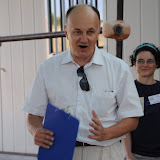
Pier Matteo Barone (center) at Gabii.

Visitors were in abundance this week. Among them were project consultants, including Dr. Pier Matteo Barone (Roma Tre) who is carrying out a new campaign of ground-penetrating radar (GPR) study at Gabii, Robyn Veal (Sydney) who is studying charcoal evidence from the site, and soil micromorphologist Dr. Cristiano Nicosia (Brussels) who is on-site to study the soils themselves and the role played by soils in the site formation. We also were visited by surveyors from the University of Texas Ostia Synagogue Area excavations

Cristiano Nicosia at Gabii.
On July 4th, 2012, Gabii hosted a half-day visit by 2012 NEH Summer Seminar ("Communication, Empire, and the City of Rome") participants in a group directed by Richard Talbert (UNC-Chapel Hill) and Michael Maas (Rice). In addition to a tour of the ancient city and the Gabii Project excavation site, the seminar participants engaged in lively discussion about networks, modelling, and 3-D digital applications and their role in documenting and reconstructing ancient world view. On Friday, July 6th, 2012, David S. Potter (University of Michigan) visited Gabii after having given a talk for the field school students at the American Academy in Rome the previous evening. Also on Friday, Dr. Fabrizio Marra (University of Rome 'La Sapienza') visited Gabii. Marra is a geologist interested in the geology of central Italy and is going to be collaborating with staff member Jason Farr (Michigan) who is carrying out a Ph.D. thesis on tufo quarries at Gabii. 

NEH summer seminar participants at Gabii.

David Potter (left) visited Gabii.

Trench tours concluded week two.

All in all, a busy week. On to week three ...

Monday, June 25, 2012

Getting oriented

25 June – today dawned hot and hazy, but our team was glad to welcome the 2012 group of student volunteers to the site who bused out from Rome to start work at 8am. Today’s time on-site was given over to the preliminary activities that must come at the start of any campaign, from the distribution of equipment and safety gear to tours of the archaeological area of Gabii and of our own site, and finishing with the students’ orientation to living in Rome conducted by Accent International. It was a busy day all around. While the students toured, the staff continued to work on-site and all is primed for a quick start to excavation tomorrow morning.


Nicola Terrenato welcomes the team to the site.


The new students receive a tour of the site.

Field director Anna Gallone discussing the side streets at Gabii.

More photos:
Gabii Project 2012 - week one

Run-up to a new campaign: Gabii pre-season 2012


Returning to Gabii, now for the sixth consecutive year of fieldwork, is always a study in contrasts. Many of us rush to Italy from university classrooms and campuses, fresh off the frantic business of ending an academic term. Arriving at Gabii, things are mostly peaceful. The vegetation has grown high, the poppies bloom, the lizards, porcupines, and harvester ants rule the site. But, a few days of hard work and the archaeological site springs back to life (and action) … but the lizards still stand their ground, reminding us who really owns the place. Thus it has been this season. The pre-season has been busy, from the expansion of our pre-existing area D and the westward expansion of the overall excavation area to create Area F, the staff has been busy preparing the site for the arrival of the full team in Rome.


This season’s goals include continued investigation of a domestic compound in Area D and the exploration of the newly defined Area F that represents part of yet another city block of the urban layout. The team has high hopes for both of these areas and we are especially interested to see the relationship between our excavation area and portions of the city excavated by the Soprintendenza in Rome a decade ago.


Joining us on-site will be over 40 student volunteers who hail from a host of colleges and universities in the United States and Canada. They will participate in all aspects of our fieldwork, including finds analysis, environmental processing, zooarchaeological analysis, and digital modeling and topography.

We are looking forward to an excellent season. Watch this blog space for more updates as the season progresses and also watch our student blog for the diggers’ points of view.
 

Monday, April 30, 2012

Gabii Project at "Ricerca in Cittadella" Giornate di studio di Archeologia e Storia dell’Arte dedicate a Roberto Coroneo

Chiara Pilo of the Gabii Project will present a paper at "Ricerca in Cittadella", Giornate di studio di Archeologia e Storia dell’Arte dedicate a Roberto Coroneo, in Cagliari, Sardinia, at the Cittadella dei Musei, Villa Pollini, held from 7 to 12 May 2012. Pilo's paper, "Una lucerna configurata da Gabii: valenze apotropaiche di un singolare strumento per l’illuminazione" focuses on an anthropomorphic lamp discovered at Gabii in 2009. Pilo's research continues to investigate both the nature of, and parallels for, this unusual Roman oil lamp; her paper is scheduled for 17:10 on Wednesday, May 9, 2012. The conference is hosted by the Università degli Studi di Cagliari and its Dipartimento di Storia, Beni Culturali e Territorio. A .pdf of the program is linked here.


Thursday, April 26, 2012

Gabii Project at ASMOSIA X

Jason Farr (Ph.D. candidate, IPCAA, University of Michigan), will present a paper on his ongoing research into the local tufo at Gabii - lapis Gabinus - and its exploitation by means of quarrying in the late republican and early imperial periods. Farr's dissertation research seeks not only to better understand this tufo type, but also to explore connections between the Gabine quarries and the construction industry in Rome and Latium. Farr's paper, "Lapis Gabinus: new evidence for quarrying at Gabii", will be presented in Rome at the ASMOSIA X (Association for the Study of Marble and Other Stones In Antiquity), conference. This international conference takes place in Rome, from 21 to 26 May 2012, and is hosted by the Università di Roma 'La Sapienza'. Farr's talk is scheduled to for 09.00am on 23 May in the session entitled "THEMATIC SESSION III: Provenance identification II: (other stones)". The conference website is here.


Friday, March 9, 2012

"Coils over Spoil – Metal detecting and archaeological interpretation at Gabii" at 22nd TRAC 2012

The use of metal detectors in Mediterranean archaeology regularly generates a lot of discussion on the internet. The Gabii Project carried out a controlled experiment using metal detectors to check stratigraphically excavated soil with metal detectors in order to track the recovery rates of metallic artifacts - and we have some interesting and significant results to share! The first look at this evidence will be offered by Laura Banducci (Ph.D. candidate, IPCAA, University of Michigan) and Jason Farr (Ph.D. candidate, IPCAA, University of Michigan), who will present their study as a poster entitled "Coils over Spoil Metal detecting and archaeological interpretation at Gabii." This presentation will take place as part of the 22nd Theoretical Roman Archaeology Conference (TRAC) taking place in Frankfurt am Main, Germany. The poster will be presented on 30 March 2012, from 5.30 to 7.00 pm.

Saturday, March 3, 2012

Gabii Project at AISCOM XVIII

The Gabii Project will share research into a series of floors discovered in the context of several Republican period buildings on the site at the upcoming eighteenth meeting of Associazione Italiana per lo Studio e la Conservazione del Mosaico (AISCOM) in Cremona, Italy, March 14 to 17, 2012. The paper presented by Anna Gallone, and authored in collaboration with Jeffrey A. Becker and Marcello Mogetta, under the title “Gabii in età repubblicana: i rivestimenti pavimentali di alcune unità abitative,” will explore the nature of several paved floors and attempt to contextualize them with respect to other archaeologically attested pavements in Republican Italy.