Applications are now being accepted from students and volunteers who wish to participate in the 2014 season.The field program will run from June 22 to July 26, 2014.
Detailed information on the application process can be found on the project website. The call has also been published on the AFOB listing of the Archaeological Institute of America.
Tuesday, October 22, 2013

Thursday, October 17, 2013
The Gabii Project on the AAR web-site
The new research portal of the American Academy in Rome highlights the partnership between the AAR and the Gabii Project.
Learn more by visiting http://aarome.org/research/archaeology-projects.

Monday, August 19, 2013
Gabii Goes Digital
Gabii Goes Digital
We are pleased to announce that the Universities of Arkansas and Michigan have been awarded an NEH ODH Start-Up grant in support of the Gabii Goes Digital: 21st c. Data, 21st. c. Publications project. This project is directed by Fred Limp and Rachel Opitz of the University of Arkansas and Nicola Terrenato of the University of Michigan, and is closely linked to the Gabii Project.
Methodological innovation has always been important at Gabii. Our recording strategy makes extensive use of digital data and 3D technologies. Since 2009, over 500 GB of data have been collected in the form of 3D models of stratigraphic layers and features such as walls, pavements and burials, photographs, surveyed measurements, written descriptions and sketches. Having created this rich digital dataset, we face the challenge of developing effective and innovative ways of publishing it. The Gabii Goes Digital project seeks to address two key challenges our project and others like it are facing: how to develop a process for the peer reviewed publication of these kinds of data, and how to build a community of peer reviewers with the skills and background to confidently evaluate these publications.
You can read more about the new project on the Gabii Goes Digital website.
Monday, August 5, 2013
Amazing Week 5 concludes Gabii Project 2013
 |
| The 2013 Team |
The final week of work at Gabii could not be more rewarding!
Impressive results were achieved in all departments of the dig, making this a
very successful season.
 |
| Hut floors emerging in Area F (with students presenting!) |
Excavation and recording continued with full steam in both areas D
and F. Bedrock was finally reached in the north part of Area D, revealing a series of
rock-cut features, such as post-holes and sunken floors, belonging to the
earliest phase of occupation beneath the Archaic compound. This horizon has been exposed also in the south sector, where the excavators identified more linear cuts and concentrations of ashy layers that sit on top of a natural level. This sequence will be the object of excavation next year.
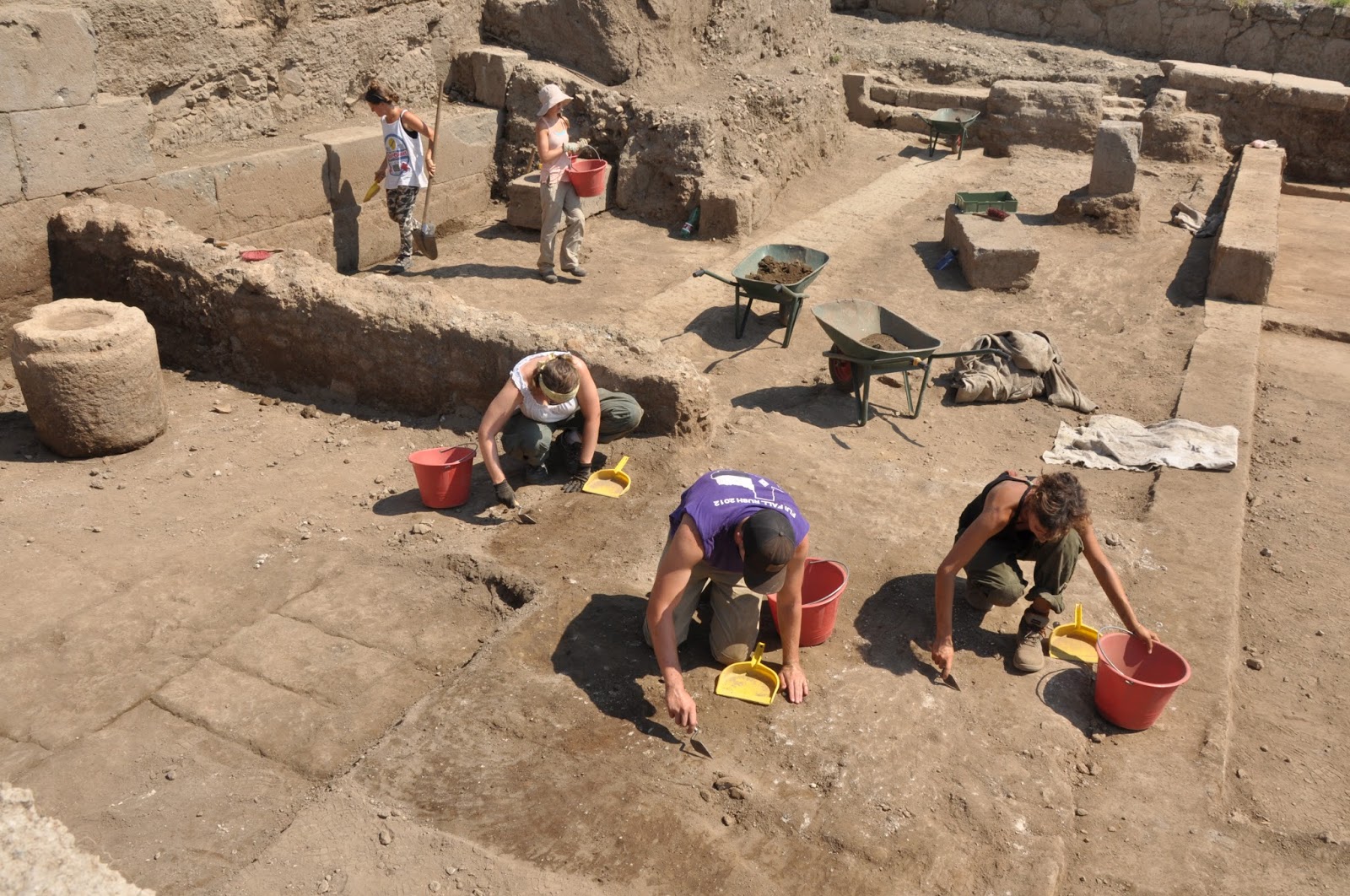 |
| Cleaning new features in Area F |
In Area F, more built structures of the monumental complex emerged
below the dumps that covered the back of the lower terrace. These features include a
very well-preserved drain made of slabs of tufo, and part of the original
pavement of this open space. The continuation of the staircase connecting the
upper and lower terraces was also uncovered, totaling 21 steps! On axis with
this, another room of the complex has been found, which features in its
northeast corner a whole dolium sunken into a cut in the bedrock.
 |
| Stepping on a column base |
A sondage was
excavated in the front part of the building, providing evidence of
modifications dating to the Early Imperial period, and exposing tantalizing architecture
(including a column base) predating the construction of the building. The west
half of the complex will be investigated in 2014.
One of the highlights of the week were certainly the presentations
given by the students on their work on site. It was incredibly gratifying to
see how much they grew as archaeologists in 5 weeks: they described the
sequence they excavated as professional diggers. As every year, the end of dig
was celebrated with a big lunch offered on site.
Looking forward to welcoming new participants and returning
students next year.
 |
| Nic Terrenato leads the final trench tour in Area F |
Sunday, July 21, 2013
New exciting data from Week 4

In Area F, the excavation progressed on different fronts simultaneously. In the north section of the lower terrace, a team continued digging the dumps that covered the large corridor at the back of the building, revealing part of a third room to the west. This was probably connected with the staircase joining the lower and upper terraces. Other important features were also uncovered, most notably the foundation trench of the monumental ashlar wall and the original surface of the upper stretch of the road delimiting the complex (this was a via glareata). Excavation of these fills will hopefully provide dating elements.
In the front part of the building, more built features were recorded. Another set of rooms at the level of the main thoroughfare was thus identified.

 |
 |
| M. Evans presents a selection of miniature votives to the students |
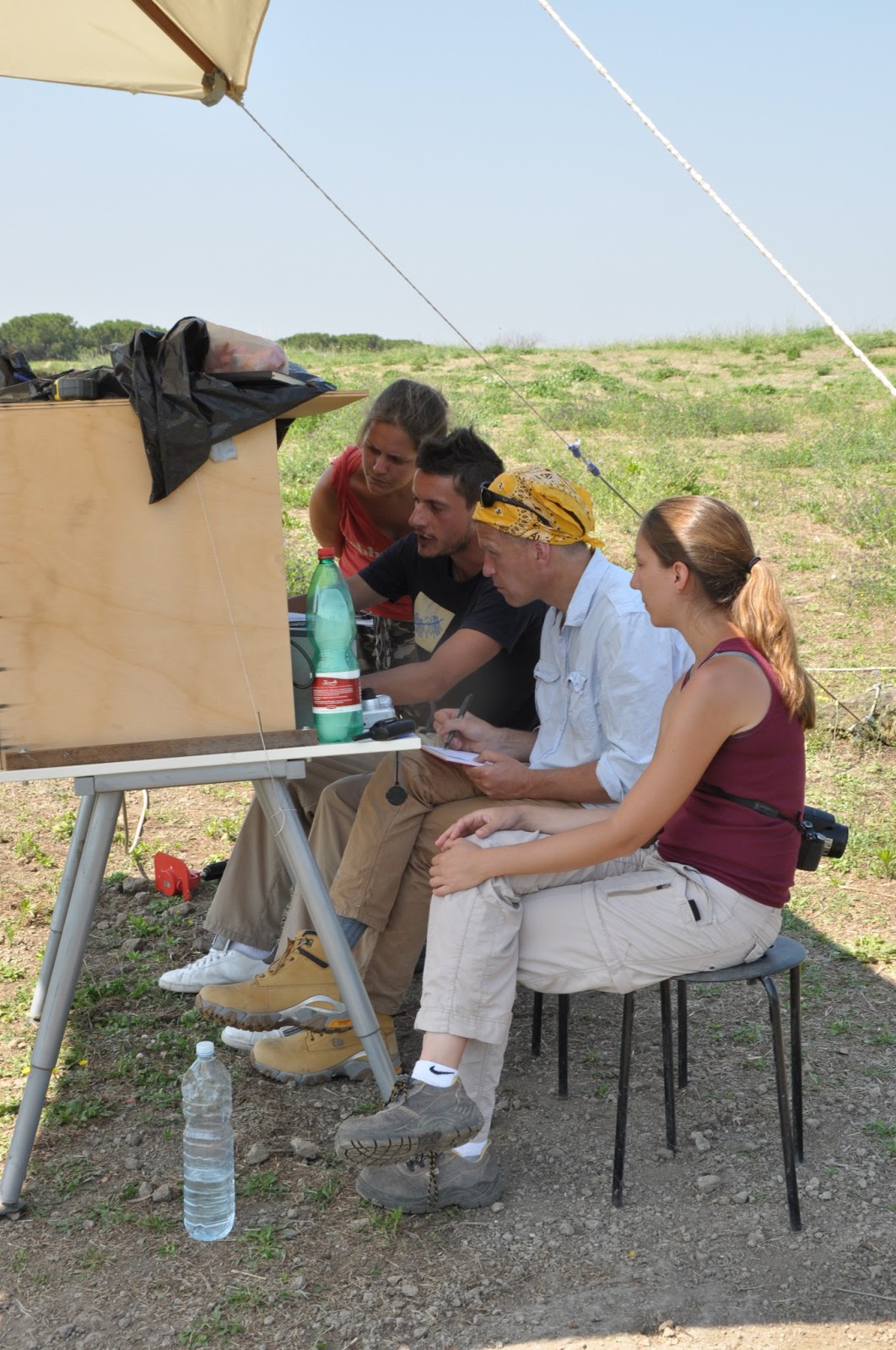 |
| Dr. Peter Rauxloh (MOLA) with the topo team |
Saturday, July 13, 2013
The Project sails swiftly through the high waters of Week 3
 There was a slight change of strategy this week, due to the inclement weather, and the large volume of water falling from the heavens over our site.
Excavation of the beaten earth surfaces in Area D was stopped and some features were covered up, in order to protect the fragile deposits from erosion. Activities, however, were not halted in Area F, where the supervisors could avail of the idle hands from Area D, with impressive results.


 |
| Anna Gallone shows the state plan of the Area F building |
 |
| David Potter and Daniele Manacorda on site |
 |
| Architects from the Consulta dei Beni Culturali visit Gabii |
Saturday, July 6, 2013
Highlights of week 2

 |
| View of one of the rooms of the Archaic compound |
 |
| The staircase of the Area F building |
In Area F, other parts of the large ashlar building have been brought to light under the leveling layers that obliterated the complex in the early Imperial period. Most notable is a staircase that connected the upper and lower terraces, and a series of rooms featuring decorated mortar floors and tufo pavements. The front and west sides of the Republican building are partly masked by concrete additions, but extensive portions are preserved under the later features, which will be the object of investigation in the coming days.
 |
Mario Torelli (to the right) with Nic Terrenato and
Anna Gallone visits Area D.
|
Subscribe to:
Posts (Atom)